Occupational Safety Law
Circular 23/2013/TT-BKHCN Regulations on measurement for group 2 measuring instruments

Apr
Circular 23/2013/TT-BKHCN is a **legal document** signed by the Minister of the MINISTRY OF SCIENCE AND TECHNOLOGY on September 26, 2013, and effective from November 15, 2013.
| MINISTRY OF SCIENCE AND TECHNOLOGY ———— |
SOCIALIST REPUBLIC OF VIETNAM Independence – Freedom – Happiness ————— |
| No.: 23/2013/TT-BKHCN | Hanoi, September 26, 2013 |
CIRCULAR
Stipulating metrology for Group 2 measuring instruments
————————————————————–
Pursuant to the Law on Metrology dated November 11, 2011;
Pursuant to Decree No. 20/2013/NĐ-CP dated February 26, 2013 of the Government stipulating the functions, tasks, powers, and organizational structure of the Ministry of Science and Technology;
At the proposal of the Director General of the Directorate for Standards, Metrology, and Quality,
The Minister of Science and Technology promulgates the Circular stipulating metrology for Group 2 measuring instruments.
Chapter I: GENERAL PROVISIONS
Article 1. Scope of Regulation
- This Circular stipulates metrology for Group 2 measuring instruments (hereinafter referred to as measuring instruments), including: List of measuring instruments, metrological control measures, and verification cycle of measuring instruments; type approval; verification of measuring instruments.
- This Circular does not apply to measuring instruments for radiation, nuclear measurements, measuring instruments that are goods granted customs preferences or exemptions, temporarily imported/re-exported goods, goods in transit, goods transferred, goods deposited in bonded warehouses, goods for urgent needs, and goods directly serving specific metrology activities in the fields of national defense and security.
Article 2. Subjects of Application
- Organizations and individuals (hereinafter referred to as establishments) producing, importing, trading, and using measuring instruments.
- Designated organizations for the verification and testing of measuring instruments.
- State agencies in metrology, and other related organizations and individuals.
Article 3. Interpretation of Terms
In this Circular, the terms below are understood as follows:
- 1. Metrological technical requirements are the set of metrological technical characteristics of the measuring instrument stipulated in the current Vietnamese metrology technical document (symbolized as ĐLVN).
- Group 2 measuring instruments are measuring instruments used for quantitative measurements of goods and services in trading, payment, ensuring safety, protecting public health, protecting the environment, in inspection, examination, judicial assessment, and in other public service activities controlled according to the metrological technical requirements stipulated in the current Vietnamese metrology technical document.
- Type approval is a metrological control measure implemented by the Directorate for Standards, Metrology, and Quality to evaluate and certify that the sample of the measuring instrument or the sample of the measuring instrument type (hereinafter referred to as the sample) conforms to the metrological technical requirements.
- Verification is a metrological control measure implemented by a designated measuring instrument verification organization to evaluate and certify that the measuring instrument ensures conformity with the metrological technical requirements.
- Measuring instrument production establishment is an organization or individual performing one or more activities of technology transfer, manufacturing, assembly, modification, or refurbishment of measuring instruments in Vietnam.
- Measuring instrument import establishment is an organization or individual importing or authorized to import complete measuring instruments.
- Measuring instrument trading establishment is an organization or individual engaging in wholesale, retail, or acting as an agent for buying and selling measuring instruments in Vietnam.
- Other terms are understood according to the provisions of Article 3 of the Law on Metrology dated November 11, 2011.
Chapter II: LIST OF MEASURING INSTRUMENTS, METROLOGICAL CONTROL MEASURES AND VERIFICATION PERIODS FOR MEASURING INSTRUMENTS
Article 4. List of measuring instruments, metrological control measures and verification periods for measuring instruments
The list of measuring instruments, metrological control measures, and verification periods for measuring instruments includes:
- Measuring instruments, metrological control measures, and verification periods for measuring instruments specified in the following table:
| No. | Name of Measuring Instrument | Metrological Control Measures | Verification Period | |||
| Type Approval | Verification | |||||
| Initial | Periodic | After Repair | ||||
| (1) | (2) | (3) | (4) | (5) | (6) | (7) |
| Field of Length Measurement | ||||||
| 1 | Tape measure | – | X | – | – | |
| 2 | Taximeter | X | X | X | X | 12 months |
| 3 | Measuring instrument for checking the speed of road vehicles | X | X | X | X | 12 months |
| Field of Mass Measurement | ||||||
| 4 | Analytical balance | – | X | X | X | 12 months |
| 5 | Technical balance | – | X | X | X | 12 months |
| 6 | Bench scale | X | X | X | X | 12 months |
| 7 | Plate scale (Platform scale) | X | X | X | X | 12 months |
| 8 | Spring dial scale | X | X | X | X | 12 months |
| 9 | Overhead leaf-spring hanging scale | X | X | X | X | 12 months |
| 10 | Hook hanging scale | X | X | X | X | 12 months |
| 11 | Road vehicle scale (Truck scale) | X | X | X | X | 12 months |
| 12 | Static rail weighbridge | X | X | X | X | 12 months |
| 13 | Dynamic rail weighbridge | X | X | X | X | 24 months |
| 14 | Belt weigher | X | X | X | X | 12 months |
| 15 | Measuring instrument for checking the load of motor vehicles | X | X | X | X | 12 months |
| 16 | Weights of accuracy class E2 | – | X | X | X | 24 months |
| 17 | Weights of accuracy class up to F1 | – | X | X | X | 12 months |
| Field of Volume and Flow Measurement | ||||||
| 18 | Fuel dispenser | X | X | X | X | 12 months |
| 19 | LPG dispenser | X | X | X | X | 12 months |
| 20 | Mechanical cold water meter | X | X | X | X | 60 months |
| 21 | Electronic cold water meter | X | X | X | X | 36 months |
| 22 | Fuel flow meter | X | X | X | X | 12 months |
| 23 | LPG flow meter | X | X | X | X | X |
| 24 | Industrial gas meter | X | X | X | X | 12 months |
| 25 | Domestic gas meter. – Qmax < 16m3/h. | X | X | X | X | 60 months |
| 26 | Domestic gas meter. – Qmax ≥ 16m3/h | X | X | X | X | 36 months |
| 27 | General volume measuring instrument | – | X | X | X | 24 months |
| 28 | Fixed tank (proving tank) | – | X | X | X | 60 months |
| 29 | Road tanker | X | X | X | X | 12 months |
| 30 | Rail tanker | X | X | X | X | 12 months |
| 31 | Automatic fuel level measuring instrument | X | X | X | X | 12 months |
| Field of Pressure Measurement | ||||||
| 32 | Bourdon tube pressure gauge | – | X | X | X | 12 months |
| 33 | Electronic pressure gauge | – | X | X | X | 12 months |
| 34 | Mercury sphygmomanometer | – | X | X | X | 12 months |
| 35 | Aneroid sphygmomanometer | – | X | X | X | 12 months |
| Field of Temperature Measurement | ||||||
| 36 | Glass-in-liquid thermometer | – | X | – | – | – |
| 37 | Minimum alcohol-in-glass thermometer | – | X | – | – | – |
| 38 | Maximum mercury-in-glass thermometer | – | X | – | – | – |
| 39 | Maximum clinical mercury-in-glass thermometer | – | X | – | – | – |
| 40 | Maximum contact electronic clinical thermometer | – | X | X | – | 6 months |
| 41 | Infrared radiation ear thermometer | X | X | X | 12 months | |
| Field of Chemical and Physical Measurement | ||||||
| 42 | Measuring instrument for moisture content of agricultural products | – | X | X | X | 12 months |
| 43 | Hydrometer | – | X | X | X | 24 months |
| 44 | Measuring instrument for total dust content in the air | – | X | X | X | 12 months |
| 45 | Measuring instrument for alcohol concentration in breath | X | X | X | X | 12 months |
| 46 | Measuring instrument for motor vehicle exhaust gas concentration | – | X | X | X | 12 months |
| 47 | Measuring instrument for SO2, CO2, CO, NOx concentration in the air | – | X | X | X | 12 months |
| 48 | Measuring instrument for pH, dissolved oxygen concentration, electrical conductivity, turbidity of water, total dissolved solids in water | – | X | X | X | 12 months |
| Field of Electrical and Electromagnetic Measurement | ||||||
| 49 | Single-phase AC electricity meter | X | X | X | X | 60 months |
| 50 | Three-phase AC electricity meter | X | X | X | X | 24 months |
| 51 | Current transformer for metering | X | X | X | X | 60 months |
| 52 | Voltage transformer for metering | X | X | X | X | 60 months |
| 53 | Measuring instrument for insulation resistance | – | X | X | X | 12 months |
| 54 | Measuring instrument for earthing resistance | – | X | X | X | 12 months |
| 55 | Electrocardiograph (ECG) | – | X | X | X | 24 months |
| 56 | Electroencephalograph (EEG) | – | X | X | X | 24 months |
| Field of Sound and Vibration Measurement | ||||||
| 57 | Sound level meter | – | X | X | X | 12 months |
| 58 | Vibration measuring instrument | – | X | X | X | 12 months |
| Field of Optical Measurement | ||||||
| 59 | Illuminance meter | – | X | X | X | 12 months |
| 60 | Focal length measuring instrument | – | X | X | X | 12 months |
-
- Where:
- Symbol “X”: The measure must be performed for the measuring instrument;
- Symbol “-“: The measure does not have to be performed for the measuring instrument.
- Where:
- Measuring instruments not specified in Clause 1 of this Article, when used for the purpose of inspection, examination, judicial assessment, and other official activities of the State, must be verified or calibrated upon request by competent state management agencies but do not require type approval.
Article 5. Amendment, Supplementation of the List of Measuring Instruments, Metrological Control Measures and Verification Cycles for Measuring Instruments
Annually, based on proposals from Ministries, Ministerial-level agencies and state management requirements on metrology, the Directorate for Standards, Metrology and Quality (hereinafter referred to as the Directorate) shall summarize and submit them to the Ministry of Science and Technology for consideration and decision on amending and supplementing the List of Measuring Instruments, metrological control measures for measuring instruments, and verification cycles for measuring instruments specified in Article 4 of this Circular.
Chapter III: TYPE APPROVAL
Section 1. TYPE APPROVAL ORDER AND PROCEDURES
Article 6. Requirements for Type Approval
- Type approval includes: registration for type approval; sample testing and evaluation; decision on type approval.
- Sample testing must be conducted by testing organizations included in the List of designated testing organizations by the Directorate.
The List of designated testing organizations is posted on the Electronic Information Portal of the Directorate.
- The sample must have a structure and technical features that prevent effects from changing the main metrological technical characteristics during use; it must be tested, evaluated, and concluded to comply with the prescribed metrological technical requirements.
- The facility manufacturing or importing measuring instruments subject to type approval must have measures to ensure that the measuring instruments produced or imported comply with the approved type.
Article 7. Application Dossier for Type Approval Registration
The facility shall prepare one (01) set of application dossier for type approval registration and submit it directly at the head office or via postal service to the Directorate. The dossier includes:
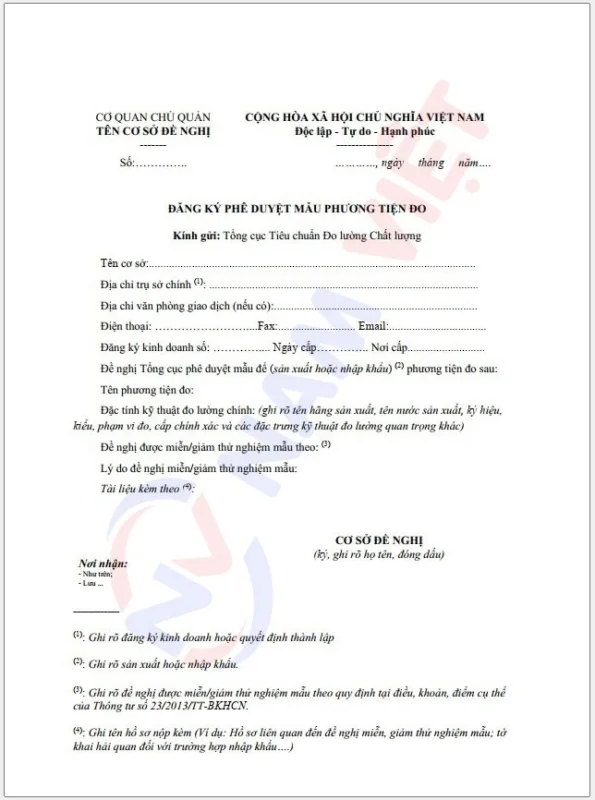
- Type Approval Registration Form for Measuring Instrument according to Form 1. ĐKPDM in the Appendix enclosed with this Circular.
- A set of technical documents for the sample. The documents must clearly state: Operating principle, structural schematic diagram, user manual; important structures affecting the main metrological technical characteristics of the sample; locations of mechanisms for setting and adjusting the main metrological technical parameters of the sample; locations for attaching seals, verification stamps/marks, sealing, and other features, if any, on the sample; the location of the mechanism or technical feature that prevents effects from changing the main metrological technical characteristics of the sample during use (in Vietnamese or English or both languages).
- A set of color photos of the sample and a CD containing this set of photos. The set of photos includes: One (01) overall photo of the sample; front (measurement result display face), back, top, bottom (if any), right, and left photos of the sample; separate photos showing information about the code, type, and characteristic of the sample’s main metrological technical characteristics; electronic circuit board (if any), operating keys; location of the sample’s goods label, location for attaching seals, verification marks; sealing locations on the sample; other parts that directly affect the sample’s main metrological technical characteristics.
Photos must be of the same size, minimum 100 mm x 150 mm but not exceeding 210 mm x 297 mm, attached or printed on A4 paper, bound into a volume. The photos must be clear, accurately show the information about the sample’s main metrological technical characteristics, and ensure the requirements for comparison, cross-checking, and checking the conformity of the manufactured or imported measuring instruments with the approved type.
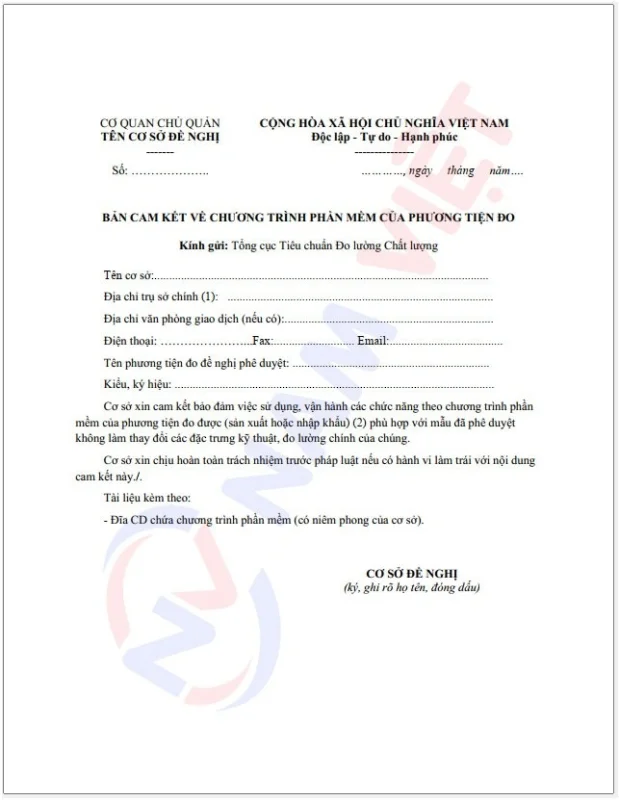
- Commitment Letter on the measuring instrument’s software program according to Form 2. CKPM in the Appendix enclosed with this Circular (applicable to cases where the measuring instrument is operated and controlled by a software program).
- A set of dossier of the sample testing and evaluation results as stipulated in Article 12 of this Circular.
In case the facility requests exemption or reduction of sample testing in the registration for measuring instrument type approval, the dossier includes documents related to the exemption or reduction of testing as stipulated in Article 10 of this Circular.
- List of documents on the establishment and application of management and technical measures to ensure that the manufactured or imported measuring instruments comply with the approved type.
Article 8. Processing of Type Approval Registration Dossier
- Within seven (07) working days from the date of receipt of the dossier, if the dossier is incomplete or invalid, the Directorate shall notify the facility in writing of the required amendments or additions.
- In cases where the dossier includes a request for exemption or reduction of sample testing but there is insufficient basis for exemption or reduction, the Directorate shall notify the facility in writing of the requirement for sample testing and/or the need to supplement and complete the type approval registration dossier.
- Within twenty (20) working days from the date of receiving the Directorate’s notice, if the facility does not have sufficient documents to supplement, the facility must send a written document to the Directorate clearly stating the reason and the completion deadline. Dossier processing will only continue after the dossier is complete and valid.
- Within ten (10) working days from the date of receiving a complete and valid dossier, the Directorate shall issue a decision on type approval in accordance with Article 13 of this Circular.
Article 9. Sample Testing
- Sample testing is chosen by the facility registering for type approval and carried out in agreement with the designated measuring instrument testing organization.
- The number of test samples and the order and procedures for sample testing shall be implemented according to the corresponding testing procedure issued by the Directorate.
- In cases where there is no testing procedure for the sample, the Directorate shall designate a testing organization to develop, submit to the Directorate for approval of a temporary testing procedure, and proceed with sample testing.
The basis for developing the temporary testing procedure is the recommendation of the International Organization of Legal Metrology (OIML), standards of the International Electrotechnical Commission (IEC), standards of the International Organization for Standardization (ISO), national standards (TCVN), local standards (TCCS), foreign standards, and relevant technical regulations related to the sample.
Article 10. Exemption and Reduction of Sample Testing
- Exemption from sample testing applies to one of the following cases:
- Imported measuring instruments having a conformity certificate from an international metrology organization or a type approval certificate from a competent metrology authority of a foreign country and whose sample testing results are recognized by the Directorate;
- Measuring instruments manufactured or imported based on a type approved for another facility, and permitted in writing by that facility;
- Measuring instruments imported as part of synchronous equipment, an equipment line under a project approved by a competent state management agency.
- Reduction of sample testing is considered and applied to one of the following cases:
- Measuring instruments modified or improved from a type approved for the facility registering for type approval, but which change one or more main metrological technical characteristics compared to the approved type;
- Measuring instruments of the same type as the one approved for the facility registering for type approval.
The Directorate shall consider and decide on the reduction and the extent of reduction of sample testing.
Article 11. Sample Evaluation
- The evaluation of the tested sample shall be carried out by the testing organization that performed the sample testing.
In cases where the sample is exempt from testing, the Directorate shall designate an organization to carry out the sample evaluation.
- Content of sample evaluation:
- The conformity of the sample testing results with the corresponding metrological technical requirements;
- The conformity of the sample’s structure and technical features with the requirement to prevent effects from changing the main metrological technical characteristics of the measuring instrument produced or imported according to the approved type during use;
- The conformity of the sample’s photos with the requirements to ensure comparison, cross-checking, and verification of the conformity of the manufactured or imported measuring instrument with the approved type;
- The conformity of the management and technical measures established and applied by the facility with the requirements specified in Clause 4, Article 6 of this Circular.
- Evaluation methods:
- Reviewing the registration dossier and related documents;
- Consulting with technical experts on relevant information;
- On-site inspection at the facility (for cases where the evaluation methods specified in points a and b, Clause 3 of this Article have been carried out but are insufficient for a conclusion).
Article 12. Dossier of Sample Testing and Evaluation Results
Upon completion of the sample testing and evaluation, the organization performing the testing and evaluation shall prepare one (01) set of dossier and submit it to the Directorate. The dossier includes:
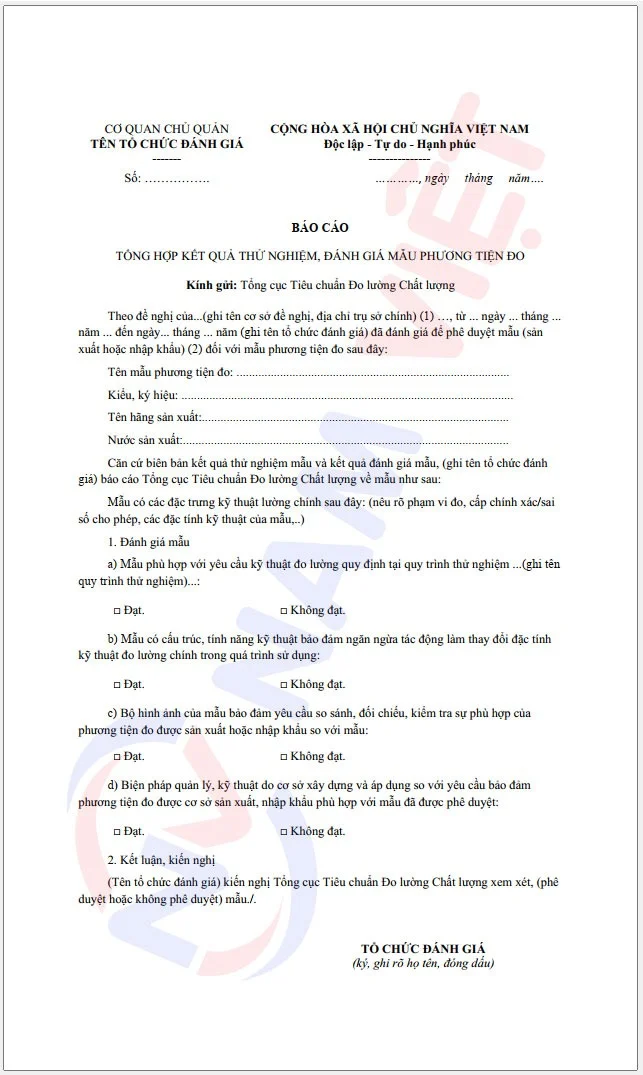
- Summary Report on Measuring Instrument Sample Testing and Evaluation Results according to Form 3. BCPDM in the Appendix enclosed with this Circular.
- Testing Certificate, testing results minutes according to the form specified in the corresponding testing procedure (for samples subject to testing).
Article 13. Decision on Type Approval
- Based on the valid type approval registration dossier and the dossier of sample testing and evaluation results, the Directorate shall consider and decide on the type approval for the facility.
In case the facility’s dossier does not meet the requirements, the Directorate shall issue a written refusal of type approval, clearly stating the reason.
- The type approval decision shall include the following main contents:
- Name and head office address of the facility;
- Manufacturer’s name, country of manufacture (for imported samples);
- Code, type of the sample;
- Main metrological technical characteristics of the sample;
- Type approval code;
- Validity period.
- Validity Period
- The validity period of the type approval decision and the extension decision is ten (10) years from the signing date;
- The validity period of the adjustment decision shall follow the most recent preceding type approval decision.
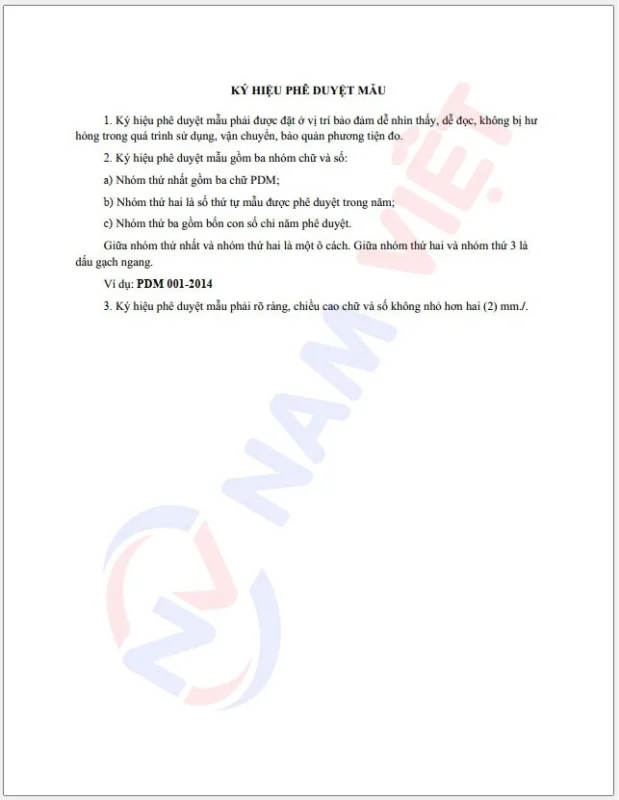
- The type approval code is specified in Form 4. KHPDM in the Appendix enclosed with this Circular.
- The type approval decision shall be sent to the facility and the local Sub-Department for Standards, Metrology and Quality where the facility registers its head office.
- The decision and images of the approved type shall be posted on the Electronic Information Portal of the Directorate.
Article 14. Retention of Approved Type Dossier
- The approved type dossier includes: The type approval decision, the type approval registration dossier specified in Article 7, and the dossier of sample testing and evaluation results specified in Article 12 of this Circular.
- One (01) set of dossier shall be retained at the Directorate. The facility is responsible for preparing one (01) set of the approved type dossier and retaining it at the facility.
- The retention period is five (05) years after the type approval decisions, adjustment decisions, and extension decisions expire.
Section 2. EXTENSION OF VALIDITY, ADJUSTMENT OF CONTENT, SUSPENSION, AND CANCELLATION OF TYPE APPROVAL DECISIONS
Article 15. Extension of Validity of Type Approval Decision
- The validity extension shall be carried out only one (01) time for one (01) type approval decision.
- One (01) month before the type approval decision expires, if needed, the facility shall prepare one (01) set of application dossier for extension and submit it directly at the head office or via postal service to the Directorate. The dossier includes:
- Request for Extension of Validity of Measuring Instrument Type Approval Decision according to Form 5. ĐNGHPDM in the Appendix enclosed with this Circular;
- A copy (certified as a true copy by the facility) of the type approval decision.
- Based on the application dossier, the Directorate shall consider and decide on the extension of validity of the type approval decision (hereinafter referred to as the extension decision) in accordance with Article 13 of this Circular.
- The extension decision and the application dossier for extension of validity shall be retained in accordance with Article 14 of this Circular.
Article 16. Adjustment of Type Approval Decision Content
- In case of a request to change the name or head office address of the facility with the approved type:
- The facility shall prepare one (01) set of application dossier for adjustment and submit it directly at the head office or via postal service to the Directorate. The dossier includes:
- Official letter requesting the adjustment;
- Documents related to the requested adjustment content.
- Within seven (07) working days from the date of receiving a complete and valid dossier, the Directorate shall consider and issue an adjustment decision in accordance with Article 13 of this Circular for the adjusted content.
- The facility shall prepare one (01) set of application dossier for adjustment and submit it directly at the head office or via postal service to the Directorate. The dossier includes:
- In case of a request to adjust contents related to points b, c, and d, Clause 2, Article 13 of this Circular:
- The facility shall prepare one (01) set of application dossier for adjustment and submit it directly at the head office or via postal service to the Directorate. The dossier includes:
- Official letter clearly stating the requested adjustment content;
- Documents related to the requested adjustment content.
- Within seven (07) working days from the date of receiving a complete and valid dossier, the Directorate shall consider and issue a written document guiding the facility to carry out new type approval or issue an adjustment decision in accordance with Article 13 of this Circular for the adjusted content.
- The facility shall prepare one (01) set of application dossier for adjustment and submit it directly at the head office or via postal service to the Directorate. The dossier includes:
- The adjustment decision and the application dossier for adjustment shall be retained in accordance with Article 14 of this Circular.
Article 17. Suspension of Validity of Type Approval Decision
- Suspension of the validity of part or all of the type approval decision applies to the following cases:
- The facility fails to fulfill its responsibilities as stipulated in Article 23 of this Circular, resulting in serious consequences;
- The facility submits a written request for the suspension of the validity of the type approval decision.
- Depending on the specific case, the Directorate shall consider and issue a decision on the suspension of the validity of part or all of the type approval decision (hereinafter referred to as the suspension decision). The suspension period shall not exceed six (06) months from the effective date of the suspension decision.
- The suspension decision shall be sent to the facility, the local Sub-Department for Standards, Metrology and Quality where the facility registers its head office, and shall be posted on the Electronic Information Portal of the Directorate.
- Within the suspension period specified in Clause 2 of this Article, after completing the remediation of the consequences caused by the failure to fulfill its responsibilities as stipulated in this Circular, the suspended facility has the right to prepare one (01) set of application dossier requesting the repeal of the suspension decision and submit it via postal service or directly at the Directorate’s head office. The dossier includes:
- Official letter requesting the repeal of the suspension decision;
- Documents and records proving the completion of the remediation of consequences.
- Depending on the specific case, the Directorate shall decide whether to conduct an inspection based on the dossier or an on-site inspection at the facility regarding the content of the remediation.
- Within seven (07) working days from the date of receipt of the dossier, if the dossier is not compliant with regulations, the Directorate shall notify the facility of the required additions or amendments.
- Within seven (07) working days from the date of receiving a complete and valid dossier, the Directorate shall issue a decision on the repeal of the validity of the suspension decision (hereinafter referred to as the repeal decision).
- The retention of the suspension decision and dossiers, and the dossier requesting the repeal of validity shall be carried out in accordance with Article 14 of this Circular.
Article 18. Cancellation of Validity of Type Approval Decision
- Cancellation of the validity of the type approval decision applies to the following cases:
- The facility with the approved type goes bankrupt, is dissolved, or seriously violates the law;
- The facility has a suspension decision that has exceeded the suspension period but has not completed the remediation of consequences;
- The facility submits a written request not to continue manufacturing or importing measuring instruments according to the approved type.
- The Directorate shall issue a decision on the cancellation of the validity of the type approval decision (hereinafter referred to as the cancellation decision).
- The cancellation decision shall be sent to the facility, the local Sub-Department for Standards, Metrology and Quality where the facility registers its head office, and shall be posted on the Electronic Information Portal of the Directorate.
Chapter IV: VERIFICATION OF MEASURING INSTRUMENTS
Section 1. GENERAL REQUIREMENTS FOR VERIFICATION
Article 19. Verification types
- Initial verification is the first verification of a measuring instrument before it is put into use.
- Periodic verification is verification conducted according to the cycle specified in Article 4 of this Circular for measuring instruments in use.
Comparative verification is a type of periodic verification performed upon request as specified in Section 2, Chapter IV of this Circular.
- Post-repair verification is the verification of measuring instruments in one of the following cases:
- The measuring instrument has been repaired due to failure to meet technical measurement requirements;
- The verification certificate (verification mark, verification seal, verification certificate) of the measuring instrument is lost, damaged, or otherwise impaired, but the structure and technical measurement characteristics of the instrument remain unchanged compared to the approved model;
- According to the conclusions of inspections or audits by competent authorities;
- The user detects signs that the measuring instrument may not meet technical measurement requirements and requests re-verification.
Article 20. Requirements for carrying out verification
- Verification is carried out by the measuring instrument facility selecting and agreeing with a designated verification organization with a suitable verification scope from the list of designated verification organizations.
The list of designated verification organizations is published on the General Department’s electronic portal.
- Verification is carried out by a metrology verifier of the designated verification organization. The verifier must be certified and issued a badge according to regulations.
- Verification is conducted following the procedures and processes specified in the corresponding measuring instrument verification process issued by the General Department.
- If a measuring instrument does not yet have a verification process, the General Department shall designate a verification organization to develop a provisional verification process for approval and conduct verification.
The basis for developing a provisional verification process includes recommendations from the International Organization of Legal Metrology (OIML), standards from the International Electrotechnical Commission (IEC), standards from the International Organization for Standardization (ISO), national standards (TCVN), internal standards (TCCS), foreign standards, and technical regulations related to the model.
- Verification certificates must follow a unified national template.
- Verification certificates must be printed, produced, issued, managed, and used according to regulations. Verification certificates issued to compliant measuring instruments are valid nationwide.
- The validity of verification certificates will cease in any of the following cases:
- The verification cycle has expired;
- Changes or improvements have altered the technical measurement characteristics of the instrument;
- The measuring instrument is damaged or does not meet technical measurement requirements;
- Verification certificates are lost, damaged, or otherwise impaired.
Section 2. REQUIREMENTS FOR COMPARATIVE VERIFICATION
Article 21. Measuring instruments requiring comparative verification
- Measuring instruments requiring comparative verification include:
- Electricity meters;
- Cold water meters.
- According to state management requirements at each stage, the General Department recommends that the Ministry of Science and Technology amend and supplement the list of measuring instruments requiring comparative verification in Clause 1 of this Article.
Article 22. Requirements for comparative verification
- The organization assigned to carry out comparative verification (hereinafter referred to as the comparative verification organization) must ensure the following:
- The comparative verification organization must belong to the list of designated verification organizations specified in Clause 1, Article 20 of this Circular;
- Regarding quantity: no fewer than two (02) organizations for one (01) type of measuring instrument requiring comparative verification in a province or centrally-run city.
- The number of instruments verified by each comparative verification organization is determined based on the total number of instruments requiring comparative verification in one (01) year within a province or centrally-run city and the local state metrology management requirements.
- The determination and announcement of the number and names of comparative verification organizations and the quantity of instruments to be verified in each organization within the locality is carried out by the General Department after consulting the local Department of Standards, Metrology and Quality.
- Comparative verification is conducted according to Clauses 2, 3, 4, 5, 6, and 7, Article 20 of this Circular.
Chapter V: RESPONSIBILITIES OF STATE AGENCIES, ORGANIZATIONS, AND INDIVIDUALS
Article 23. Responsibilities of manufacturers and importers of measuring instruments
- Implement the approval of instrument models as specified in Chapters II and III of this Circular when manufacturing or importing measuring instruments.
- Manufacture or import instruments according to the approved models.
- Take measures to prevent interference that alters the main technical measurement characteristics during use.
- Perform initial verification according to Chapter IV of this Circular.
- Comply with inspections and checks by competent state metrology authorities as required by law.
- Follow the regulations of this Circular and other relevant legal provisions.
- Annually, before March 31, or as required, submit reports on production and import activities to the General Department.
Article 24. Responsibilities of businesses trading measuring instruments
- Trade measuring instruments that have been approved according to regulations.
- Provide customers with information about the technical measurement characteristics of the instruments.
- Comply with inspections and checks by competent state metrology authorities as required by law.
Article 25. Responsibilities of measuring instrument users
- Ensure proper storage and usage conditions as specified by the manufacturer and state metrology authorities.
- Perform periodic and post-repair verification according to Chapter IV of this Circular.
- Comply with professional qualification and experience requirements for users performing grouped measurements as required by competent metrology authorities.
- Ensure conditions for authorized persons to supervise and inspect measurement methods, instruments, and goods quantity.
- Comply with inspections and checks by competent state metrology authorities as required by law.
Article 26. Responsibilities of designated verification and testing organizations
- Carry out verification and testing of measuring instruments according to this Circular.
- Meet customer verification and testing requests, except in cases of force majeure.
- Manage the production and usage of verification and testing certificates according to regulations.
- Manage verification and testing activities of verifiers and testing personnel.
- Comply with inspections and checks by competent state metrology authorities.
- Annually, before March 31, or as required, report verification and testing activities to the General Department and local Departments of Standards, Metrology and Quality.
Article 27. Responsibilities of the General Department of Standards, Metrology and Quality
- Issue Vietnamese metrology technical documents on technical requirements, verification and testing procedures.
- Approve measuring instrument models.
- Designate verification and testing organizations according to regulations.
- Annually, before June 30, or as required, notify local Departments and relevant entities of the number of instruments requiring comparative verification and the organizations assigned to perform them.
- Inspect and check compliance with this Circular according to law.
Article 28. Responsibilities of Departments of Science and Technology of provinces and centrally-run cities
- Direct local Departments of Standards, Metrology and Quality to perform state metrology inspections as prescribed in Clause 3, Article 13 of Decree 86/2012/ND-CP dated 19/10/2012.
- Direct the State Inspectorate to conduct inspections, handle complaints, denunciations, and violations regarding metrology according to law.
Article 29. Responsibilities of local Departments of Standards, Metrology and Quality
- Inform, propagate, and guide organizations and individuals to comply with this Circular.
- Conduct state metrology inspections on instruments within the scope specified in Clause 3, Article 13 of Decree 86/2012/ND-CP.
- Annually, before May 30, or as required, report on comparative verification, propose numbers of instruments requiring verification, and designated organizations to the General Department and local Departments of Science and Technology.
Chapter VI: IMPLEMENTATION PROVISIONS
Article 30. Effective date
- This Circular takes effect from November 15, 2013.
- The following documents are repealed:
- Decision No. 1073/QD-BKHCNMT dated 17/5/2002 on issuing verification procedures;
- Decision No. 65/2002/QD-BKHCNMT dated 19/8/2002 on the list of instruments to be verified and registration;
- Decision No. 22/2006/QD-BKHCN dated 10/11/2006 on approval of instrument models;
- Decision No. 13/2007/QD-BKHCN dated 6/7/2007 on the list of instruments requiring verification;
- Decision No. 25/2007/QD-BKHCN dated 5/10/2007 on application of verification procedures and cycles;
- Decision No. 11/2008/QD-BKHCN dated 29/8/2008 amending the list of instruments requiring verification;
- Circular No. 14/2011/TT-BKHCN dated 30/6/2011 amending Decision No. 22/2006/QD-BKHCN on approval of instrument models.
Article 31. Transitional provisions
- Measuring instruments in use before the effective date but not yet approved shall have approval dossiers submitted to the General Department according to Clauses 1–4, Article 7 of this Circular.
Based on the quantity and types of instruments proposed for approval, the General Department may inspect documents or conduct on-site assessments. Costs are borne by the organization.
- Manufacturers or importers with valid approval certificates under Decision 22/2006/QD-BKHCN may continue production/import according to approved models until the certificate expires.
Article 32. Implementation
- The General Department of Standards, Metrology and Quality shall guide and organize the implementation of this Circular.
- State agencies, organizations, and individuals concerned are responsible for compliance.
- Any difficulties encountered should be reported to the Ministry of Science and Technology for resolution.
|
Recipients:– Prime Minister; |
ON BEHALF OF MINISTER DEPUTY MINISTER(Signed)Tran Viet Thanh |
APPENDIX: TEMPLATES
(Issued together with Circular No. 23/2013/TT-BKHCN dated September 26, 2013 of the Minister of Science and Technology)
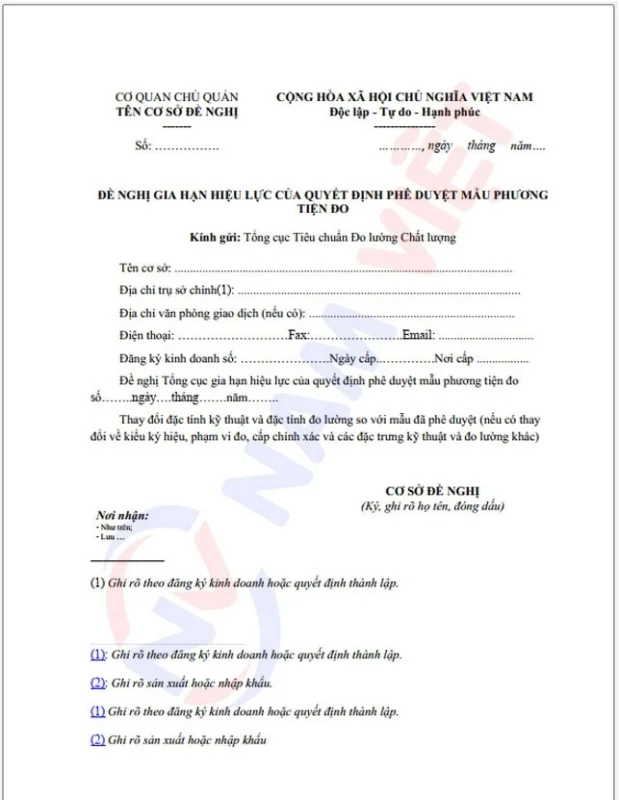
Template 1. Measuring instrument model approval registration
Download soft file (.docx & .pdf)
Template 2. Commitment regarding software of measuring instruments
Download soft file (.docx & .pdf)
Template 3. Summary report of test results and instrument model evaluation
Download soft file (.docx & .pdf)
Template 4. Model approval code
Download soft file (.docx & .pdf)
Template 5. Request for extension of instrument model approval decision
Download soft file (.docx & .pdf)